
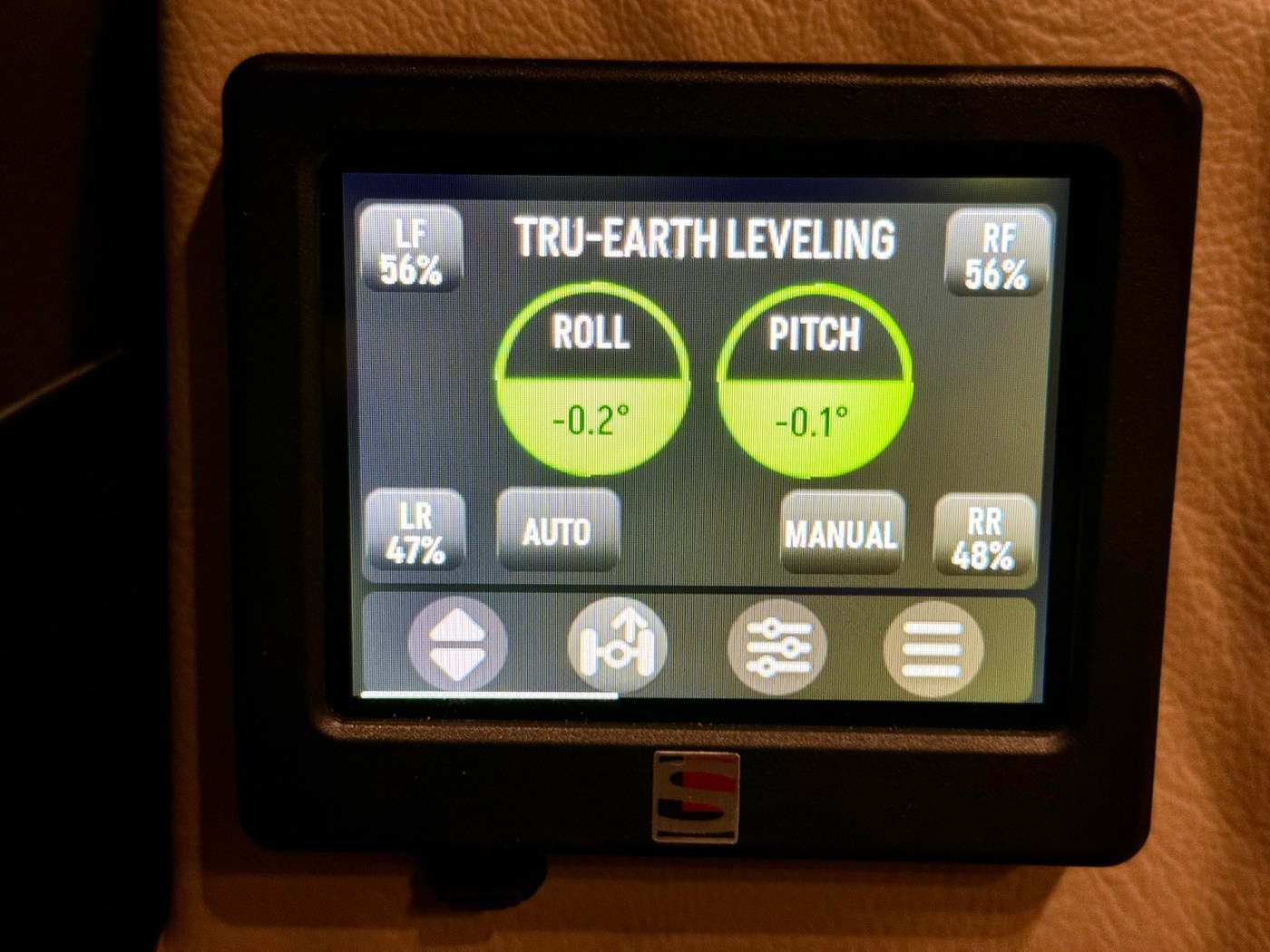
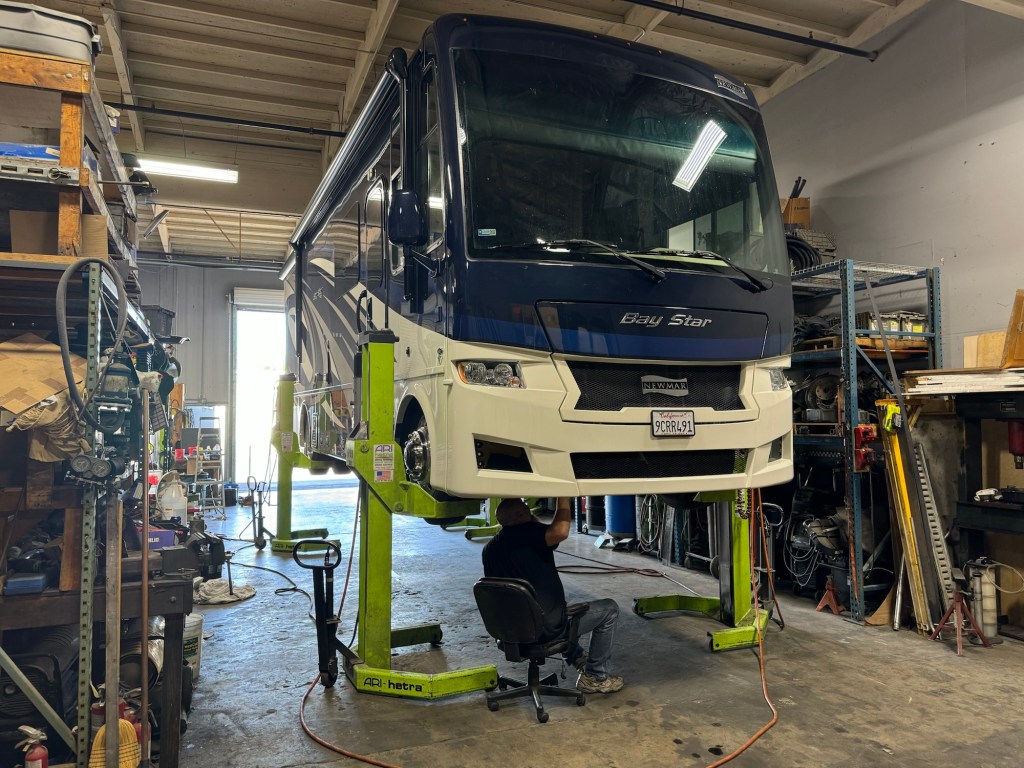
I recently went back to DZ Services in Sacramento to have my Liquid Spring Suspension upgraded with Tru-Earth Leveling.
It was 2 years ago, the week after I bought my 2023 Newmar Baystar 3014, that I drove to Sacramento to have Liquid Spring Suspension installed and I have been very happy with the smoother and more stable ride.
For more info on what Liquid Spring Suspension is, I’ll link to my install post.
The Liquid Spring Suspension improved my ride. The Tru-Level upgrade promised to improve my camping experience, too!
To complete the upgrade, Don replaced the interface in the cab with a new digital one, replaced the four rate valves with ones that are normally closed, and replaced the Electronic Control Unit (ECU). The whole job took just a few hours.
Tru-Earth leverages your Liquid Spring Suspension to also level the motorhome. That’s right, no jacks required! The process is simple. You press the “auto-level” button and it quickly and smoothly levels the coach. Because it’s so easy, I tend to use it more often — at rest stops, dump stations, storage — anywhere having a level coach is desirable.
I just returned from a 2,000 mile trip up to Seattle and down the Oregon coast. We stayed a 8 different RV parks over five weeks, and we never used our jacks once! More than once, I noticed people scratching their heads as they walked by our motorhome, noticing that we were level but our jacks were not down. It made setting up camp and getting ready to drive a little easier each time. Also, there are no worries forgetting to exit Tru-Level, as it automatically goes back to normal when the coach moves.
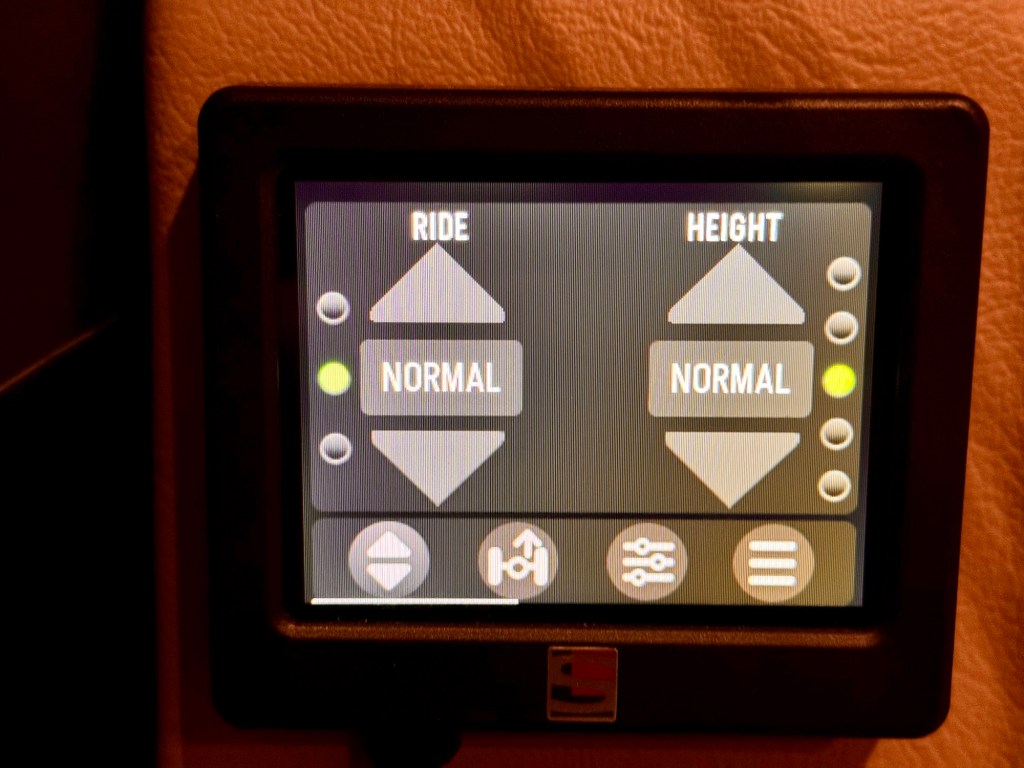
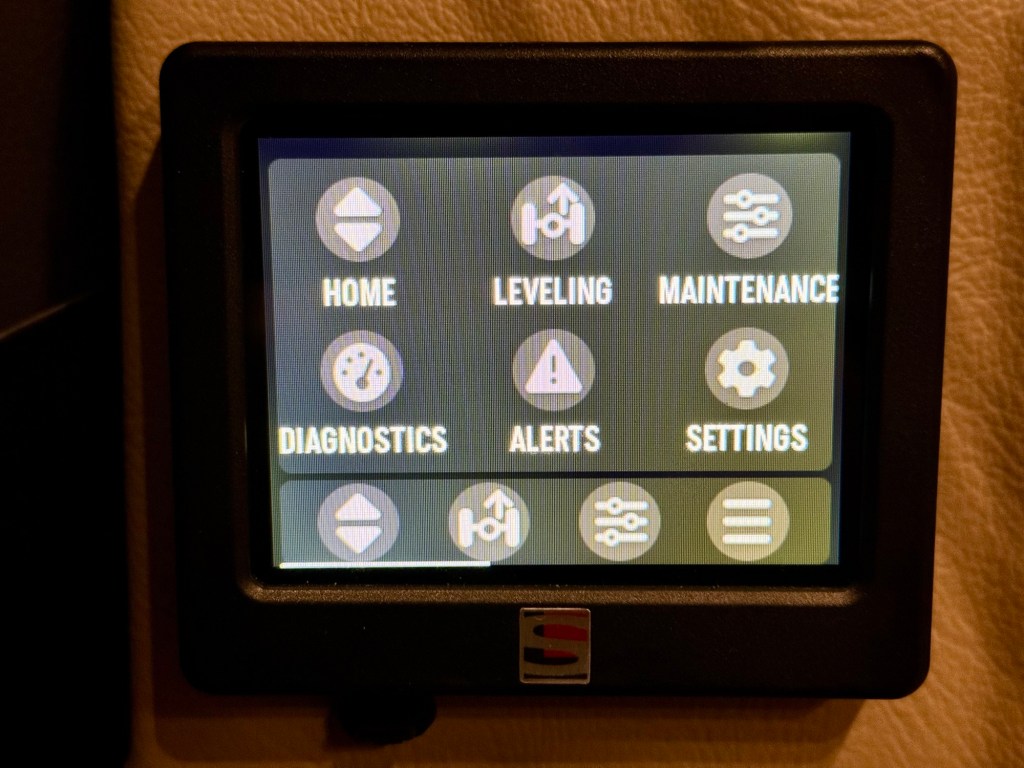
I found the control interface to be easy and intuitive to use. The Home screen resembles old old drive screen, where you can adjust the ride and height of the system while underway.
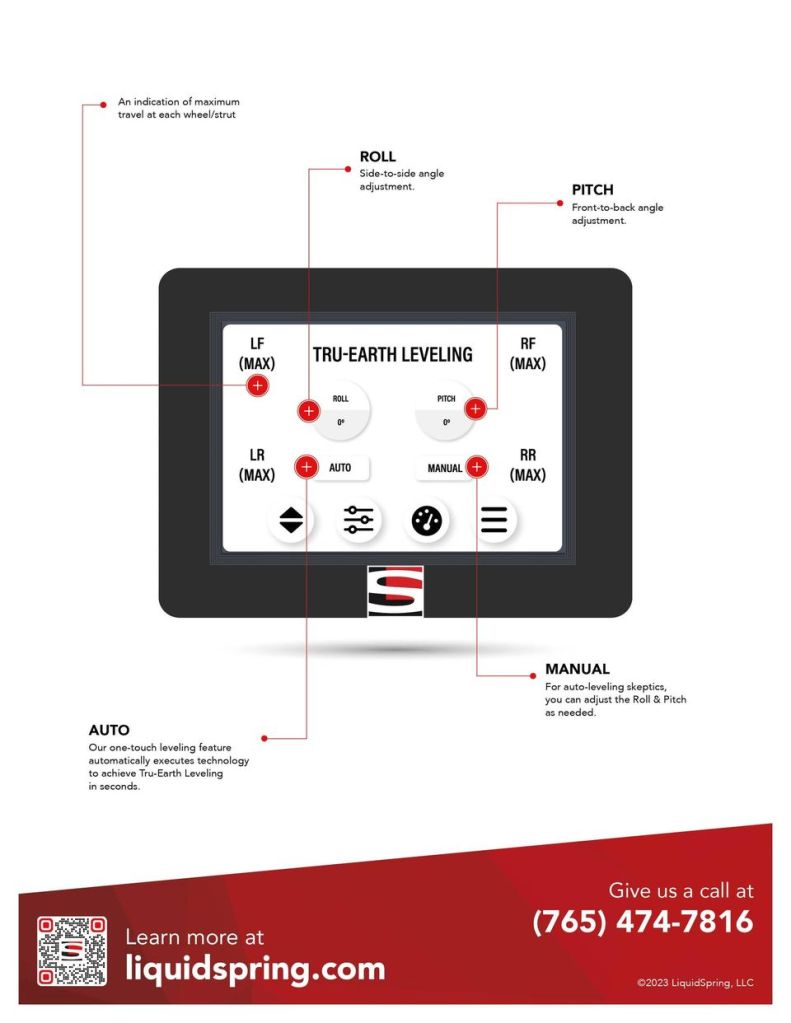
The next screen is for Tru-Earth Leveling. For right now, I use the auto-level button to level when parked, and the exit screen to return to normal ride height. The manual function will be active in a future release.

I like the visual representation of the roll (side to side) and pitch (front to back) of the motorhome. In each corner, a percentage indicates how much of the suspension travel has been used. From normal height, the system can travel about 3 inches up or 3 inches down. At normal height the percentage would be 50% for each corner. If all four corners were lowered all the way, it would be 0%. Since each corner is adjusted individually, the floor of the motorhome stays truer than when using jacks, which tend to tweak the floor a little, depending on how flat the ground is. For those with full-length slides, this is a good benefit.
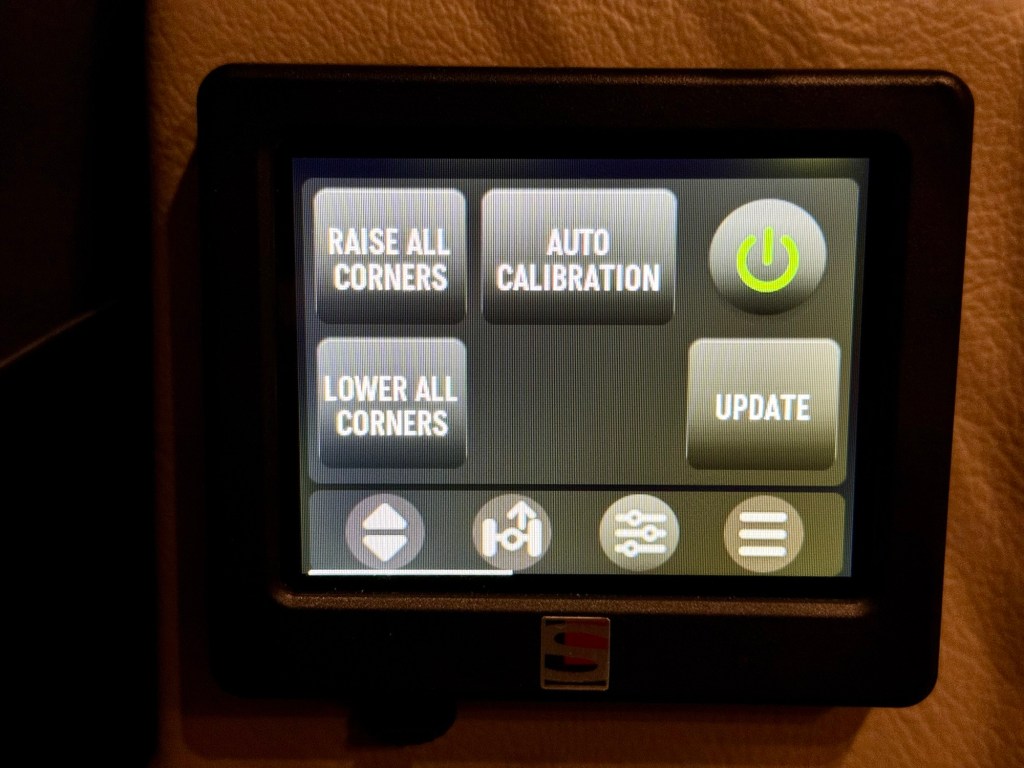
The next screen is for Maintenance, and allows you to calibrate the system, including what it thinks is level.
The last screen is the menu screen, which gives you access to some user adjustable settings, as well as the diagnostics and alerts page.
The best way to show how it operates is to show it in a video, which I’ll do below. I’ll start the engine, let the system equalize pressure and return to normal ride height, then I’ll level the motorhome. Notice how quick and smooth it is (the ground is pretty level at my storage, but it has never taken more than 30 seconds to level.). I’ll then exit Tru-Level and return to normal height.
Note when camping, I usually lower the front and rear before leveling. Beta testers have found this to consistently level at the lowest height possible.
I’m really happy I had the system upgraded! However, as an early adopter, I had to work with Liquid Spring Customer Service through some growing pains that is typical of new systems. My ECU was faulty and randomly had to be rebooted by pulling a fuse.
However, Liquid Springs customer service came through with flying colors. They overnighted a new ECU to my installer. It took him 30 minutes to install the new unit, and I have been trouble-free since then.
By the time you read this, Liquid Spring will have this issue behind them. They are a great company and I truly appreciate Wayne and Neal from Liquid Spring, and Don from DZ Services, for quickly resolving the issue with my unit.
I’ll summarize by listing the positives and negatives about the system. In my opinion, this is definitely an upgrade you want if you already have Liquid Spring Suspension installed, and a definite add-on for new installations.
Positives
- Easy and fast to use.
- Very smooth leveling. No jerking at all when leveling or going back to normal.
- Range can be greater than your hydraulic jacks because Liquid Spring can both lower and raise the suspension. Jacks always have to start at normal suspension height and can never go lower than that. This gives Liquid Spring more flexibility, and enables it to level at a lower height than most if not all OEM jack systems.
- Software can be updated by the user by email, and hopefully by the app in the future. Mac users currently need to have a thumb drive sent in order to update software, but I expect that will be resolved shortly.
- Liquid Spring customer service is great to work with and they have a good dealer network if issues arise.
- Tru-Level provides safer leveling. It will never lift your wheels off the ground, sink into the grass, or hit a rock. No need for jack pads!
- At some point, many people will have a problem with their jacks. With Tru-Level there is no jack anxiety!
Negatives
- There is slightly more movement inside when leveled. Some people have reported that it’s more stable, so I’ll qualify that by saying for my RV. It makes sense to me, since you are resting on rubber tires. However, its minimal, and my wife says she never noticed it after the first day.
- The corners may move slightly with the weather or because of a hot engine. This affects mainly the front suspension. It was never noticeable to me, but my Level-Mate Pro showed a little movement throughout the day. Not a big deal for us, but for full disclosure. If you notice a difference after the engine cools, just re-level. It can be done easily with your slides out. Just exit the system, let it equalize pressure, and re-press auto-level.
- I can feel the rate valves adjusting when pressure is equalizing and sometimes when underway. This is not annoying, but I never felt it with the old rate valves.
- The cost is somewhere between $700 and $2,300, depending on how recent your initial install was. Since you already made the large investment for Liquid Spring Suspension, this is a reasonable cost for such a major benefit (again, IMHO).
- Tru-Level is early in its roll-out, and not all features are available yet. Manual leveling and other features will be in a future software upgrade. If you are like me, being an early adopter is part of the fun. However, if you don’t want any surprises, I’d give it a few months.
- Note for Newmar owners: To fully use the range Tru-Level provides, you will need to cut off the third step. This is easy to do, and we haven’t missed it. At times, the front will be raised to where you may want to use a portable step, like many Diesel Pushers use. We needed it once on our trip with 8 stops.
OK, that’s my review of the Tru-Level upgrade for Liquid Spring Suspension. I’d love to hear your experience, so please comment.
Thanks,
Al

 MobileMosers.com
Great Review and sounds like you are having fun with it.
Mel
Thanks Mel! Yes, we have 19000 miles on our 2 year old motorhome! Enjoying the trips, and also enjoy maintaining and improving the motorhome. Both are part of the experience!